
Stop Losing Saved Content: My Obsidian Discovery System
- 17/01/2026
Description
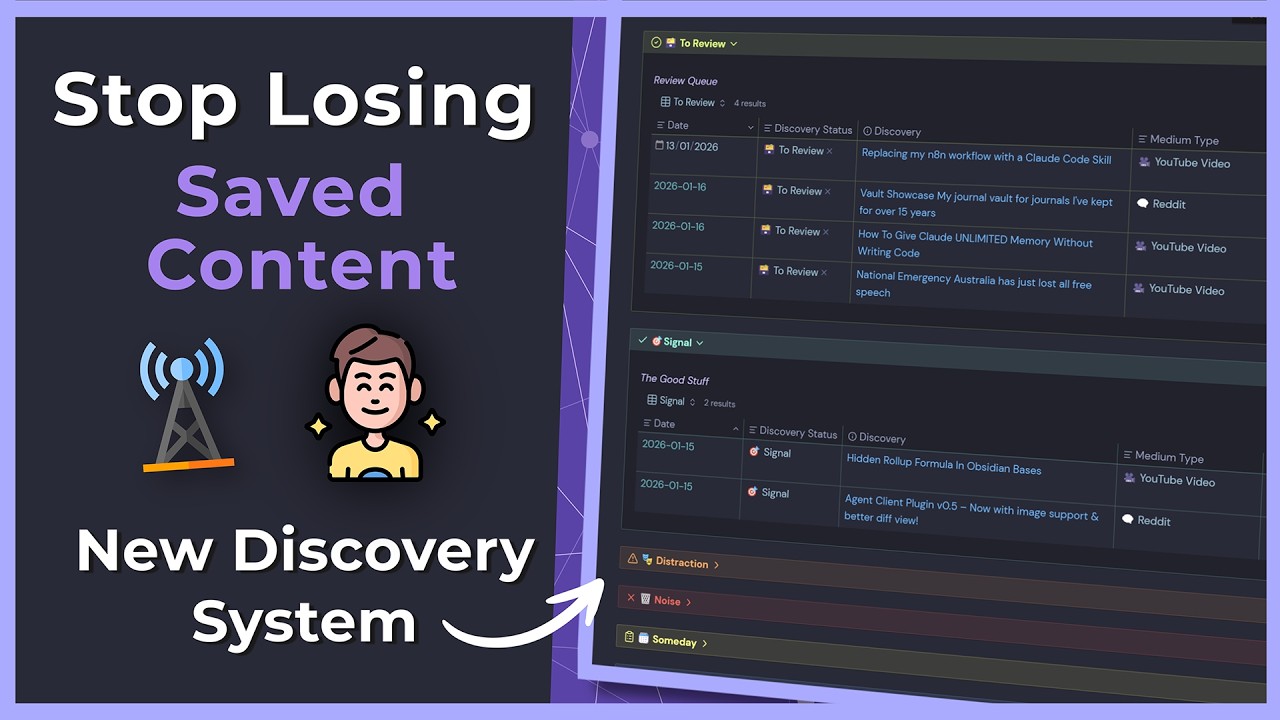
This video introduces a personal Content Discovery System built in Obsidian designed to combat digital distraction and prevent valuable saved content from being lost. The system focuses on a rapid “capture first, review later” approach for online content, which is then systematically filtered into actionable categories (signal, someday, distraction, noise) within a dedicated Obsidian workspace. This ensures content is actively processed rather than accumulating in neglected digital “graveyards.”
Best Ideas
1. Capture First, Review Later: The core principle is to quickly capture any attention-grabbing content using hotkeys and templates without immediate processing, separating the act of saving from the act of engaging.
2. Systematic Content Filtering: Content is categorized into distinct statuses (To Review, Signal, Someday, Distraction, Noise, Applied, Archived) to differentiate valuable, actionable insights from mere information overload or attention sinks.
3. The “Hook” Mechanism: Capturing “what got your attention” (the hook) when saving content helps recall the initial interest during review, making the filtering process more efficient and intentional.
4. Integrated Workflow in Obsidian: By centralizing content discovery within Obsidian, the system integrates saved items directly into one’s daily knowledge management workflow, preventing them from being forgotten in external tools.
5. “Call Mining Metaphor”: Acknowledging that most captured content will be “noise or distractions” is a healthy mindset, reframing content discovery as a process of mining for valuable “gems” rather than expecting every save to be profound.
6. Review Queue with a “Zero Goal”: Content enters a “To Review” queue, with the implicit goal of processing all items regularly (daily/weekly) to keep the queue clear, ensuring saved content doesn’t pile up indefinitely.
Tools and Resources
- Obsidian: The primary personal knowledge management software used to build and operate the system.
- Quick Add (Obsidian Plugin): Used for rapid content capture via hotkeys and templates, facilitating the “capture first” step.
- Modal Forms (Obsidian Plugin): Creates custom input forms for structured data entry, used for the “New Discovery” form to capture title, URL, medium, purpose, and hook.
- Metabind (Obsidian Plugin): Utilized for creating interactive buttons within Obsidian notes and managing input field templates for statuses.
- Dataview (Obsidian Plugin – *Implied*): Though not explicitly named, the “bases view” and filtering mechanisms for displaying and organizing discoveries by status (e.g., “To Review,” “Signal,” “Distraction”) strongly indicate the use of Dataview queries.
- Workspace Plus (Obsidian Plugin): Used for managing and quickly switching between different workspace layouts, such as the “Content Discovery System” workspace.
- YouTube: A primary source for discovering video content.
- Reddit: Another source for discovering articles and community discussions.
- Kofi: Platform where the pre-configured system can be purchased for those who prefer not to build it from scratch.
Key Learning Points
- Combatting Information Overload: A structured system is essential to manage the vast amount of online content and prevent it from becoming a source of distraction rather than learning.
- Value of Intentional Review: Simply saving content is not enough; a dedicated review process is crucial for discerning what is truly valuable and actionable.
- Avoiding “Saved Content Graveyards”: Decentralized saving across multiple tools often leads to content being forgotten. Integrating content discovery into a primary workflow tool (like Obsidian) ensures engagement.
- Customization for Productivity: Obsidian’s plugin ecosystem allows for highly personalized and efficient workflows that cater specifically to individual needs, such as content discovery and filtering.
- Focus on Actionable Insights: The ultimate goal of content discovery should be to identify “signals” that lead to learning, organization, distillation, and expression, rather than just passively consuming or saving.