
Unlock the Power – Master Book Notes with Obsidian Canvas
- 24/04/2024
Description
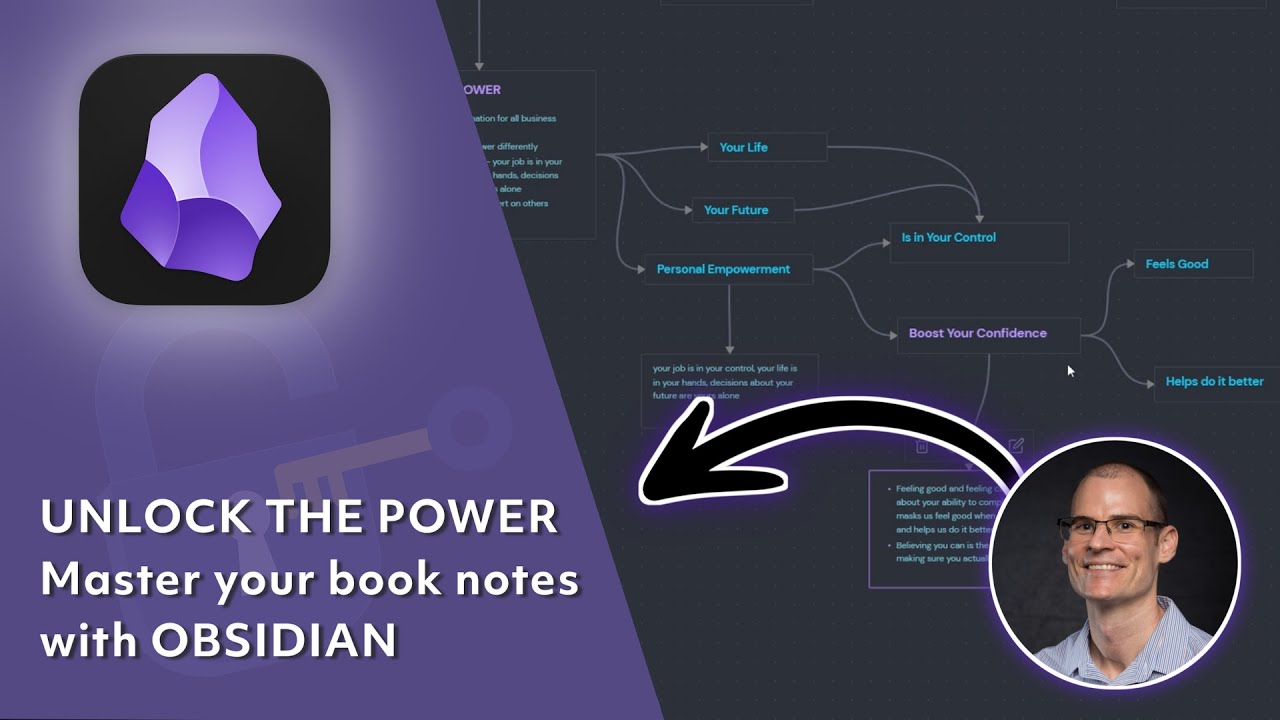
This video demonstrates how to overcome the challenge of retaining knowledge from books by leveraging Obsidian, particularly its Canvas feature. It outlines a comprehensive workflow for capturing book highlights from various sources, processing them with AI, organizing them in Obsidian, and then visually structuring them into interactive mind maps for enhanced memory, understanding, and retention.
Best Ideas
1. Obsidian Canvas for Visual Mind Mapping: Utilize Obsidian Canvas’s non-linear, freeform environment to organize notes and ideas, mimicking traditional mind mapping, which is proven to enhance memory through imagery and color.
2. Streamlined Highlight Capture Workflow: Employ tools like Calibre to transfer Kindle highlights and an AI (specifically Claude) to strip repetitive headings, allowing for efficient import and initial formatting within Obsidian.
3. Holistic Note Integration: Embed diverse media types (images, PDFs, videos, audio, and fully interactive web pages) directly alongside text notes within Canvas, creating an expansive, interconnected visual workspace for learned information.
4. Mirroring Brain Function for Learning: Understand that mind maps resonate with how our brains make associations, stimulating ideas and making information extraction and retention easier and more enjoyable.
5. Reflect and Refine for Deeper Understanding: Actively engage with the created mind maps by reviewing, reorganizing, and linking notes to prioritize important concepts, improve comprehension, visualize the bigger picture, and boost learning motivation.
6. Connecting Concepts Across Your Vault: Actively link specific book notes and ideas to existing concepts within your Obsidian vault (e.g., discipline, mindset, productivity), fostering a richer, interconnected personal knowledge base.
7. Embracing “Play” and “Power” in Learning: Apply principles from “FeelGood Productivity” like using “play personalities” to make tasks enjoyable and adopting the “Shoshin” (beginner’s mind) approach for continuous curiosity and openness, boosting personal empowerment in learning.
Tools and Resources
- Obsidian: A powerful, free knowledge management software for notes and personal knowledge bases.
- Obsidian Canvas: A core plugin within Obsidian for visual thinking, mind mapping, and freeform organization of notes.
- Blinkist: An app/service for obtaining summarized key points from books in short formats.
- Calibre: A free and open-source ebook manager for Windows, Mac, Linux, Android, and iOS, used for transferring ebooks and managing highlighted notes.
- Kindle: An e-reader device used for reading and highlighting key points in books.
- Claude (AI tool): Mentioned for stripping repetitive headings from exported highlighted notes.
- Book Notes Template: A structured format suggested for capturing and organizing notes within Obsidian.
- Mind Mapping (Technique): The core organizational and learning technique advocated by the video, facilitated by Obsidian Canvas.
- Grouping Feature (Obsidian Canvas): Allows easy grouping and movement of related notes on the canvas.
- Embedding Feature (Obsidian Canvas): Enables the integration of various media types (images, PDFs, videos, audio, web pages) directly into the visual workspace.
- Ali Abdaal’s “FeelGood Productivity”: A specific book used as an example to demonstrate the note-taking and mind-mapping process.
- Local Graph View (Obsidian): A feature within Obsidian to visualize connections between notes.
Key Learning Points
- Obsidian Canvas Workflow: Learn a step-by-step process to transform raw book highlights into organized, visually engaging mind maps using Obsidian Canvas.
- Benefits of Visual Learning: Understand how non-linear organization and mind-mapping techniques significantly enhance memory, recall, and comprehension by engaging visual and associative brain functions.
- Efficient Note Capture & Processing: Discover practical methods for effectively extracting highlights from digital books (Kindle, Calibre) and leveraging AI for initial cleanup before detailed organization in Obsidian.
- Active Engagement for Retention: Recognize that actively interacting with your notes by formatting, linking, and creating visual structures leads to deeper understanding, improved motivation, and long-term retention of learned material.
- Interconnected Knowledge Building: Grasp the importance of linking new book knowledge to existing concepts within your personal knowledge management system to foster a more robust, integrated, and accessible understanding.